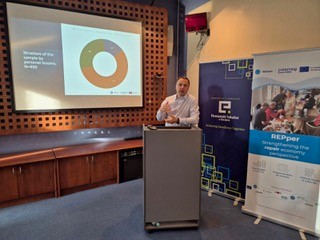
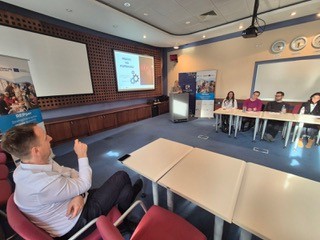
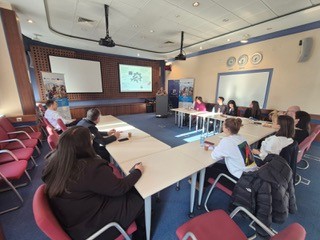
On 18 December 2025, the REPper Hub in Bosnia and Herzegovina hosted an innovative training session at the School of Economics and Business, University of Sarajevo.
The session, titled “Educating for Repair: EU Frameworks and Opportunities for Green Transition”, targeted academic staff from four UNSA faculties: the School of Economics and Business, Faculty of Pedagogy, Faculty of Science, and Academy of Fine Arts.
By engaging university educators, the training aimed to embed circular economy and repair principles across academic disciplines, ensuring the knowledge is transferred to future professionals and continues to influence teaching and research practices.
The pilot phase included three training sessions with a total of 11 participants. These influential educators were encouraged to explore how repair, sustainability, and green jobs can be integrated into their professional and academic contexts.
Inside the Training: From Policy to Practice
The one-day training blended EU policy insights, hands-on perspectives, and open discussion, guiding participants through five interconnected sessions that moved from context to real-world application.
Setting the Scene. Participants explored the goals of the session, the growing importance of the Right to Repair in reducing waste across Europe, and Bosnia and Herzegovina’s role in the circular economy transition.
Understanding the Right to Repair. The training outlined the EU legal framework, including Directive (EU) 2024/1799, the Ecodesign for Sustainable Products Regulation, and measures empowering consumers in the green transition.
Repair in Practice and Cultural Change. Discussions moved beyond policy to repair as a mindset, covering durability, reuse, planned obsolescence, and the role of education in shaping conscious consumption.
Economic and Social Benefits. Participants examined cost savings, emerging green jobs, and opportunities for SMEs, vocational centres, and universities, with a focus on local relevance.
Wrap-up and Exchange. The session closed with reflection and an interactive Q&A, linking policy insights to real-world applications.
How Educators Benefited
By the end of the training, participants were equipped to:
- Clearly explain the EU Right to Repair Directive and its implications for manufacturers, consumers, and repair services
- Understand how ecodesign, circular economy strategies, and consumer empowerment support sustainable consumption
- Identify the environmental, economic, and social value of repair, from waste reduction to climate benefits
- Recognize emerging green jobs and business opportunities within the repair economy
- Critically assess barriers to repair culture, such as planned obsolescence and limited access to services
- Apply their learning in teaching, research, policy-making, SME development, and civic engagement
A participant perspective: “This training empowered university professors to translate the EU Right to Repair agenda into teaching, research, and policy engagement—linking ecodesign and circular economy strategies with real socio-economic benefits, from waste reduction and consumer savings to new green jobs and sustainable business opportunities.”